The Waveform Tube Mode: Rings Cut From the Waveform
Every ring in the Tunnel engine keeps the moment it was born. In Waveform Tube that moment is the waveform's own shape, so each ring flying toward you is a cross-section of the sound as it was.
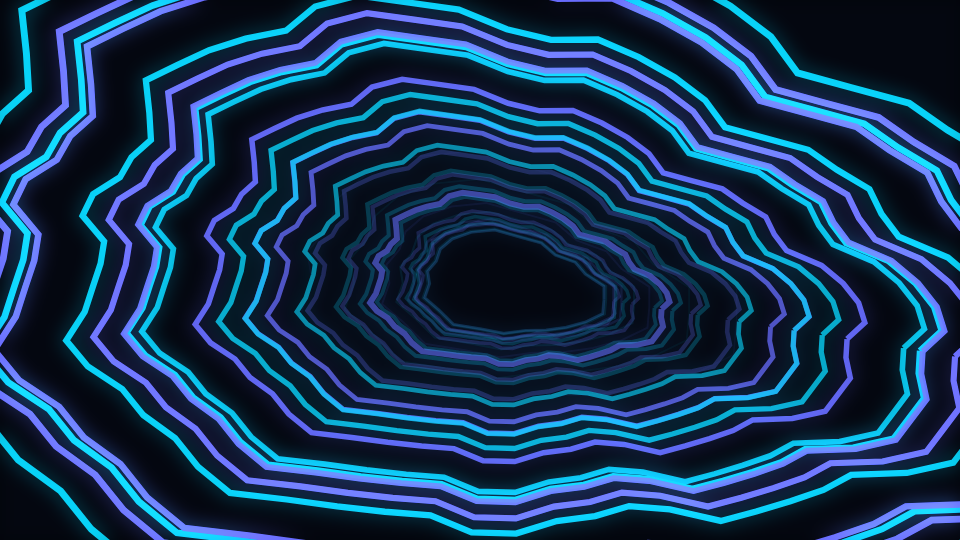
Waveform Tube is described in the catalogue like this: thin rings of light, each the waveform's shape at the moment it appeared, flying toward you down a dark tube. It flies the same lit corridor as the rest of the Tunnel engine and changes one thing, what each ring carries.
A ring carries the moment it was born
The engine's central idea is that a ring has an identity. Rings stand at fixed places along the tube and the camera flies toward them; when a new ring appears at the far end it freezes what the track is doing at that moment and carries it all the way in. In the other modes that is 64 bands of the spectrum, mapped round the ring with the bass at its bottom. The corridor is therefore a record of the last few seconds of the track, read from the far end toward you.
Here the moment is the waveform
In this mode a ring freezes 64 samples from the middle of the waveform buffer instead, laid round it and mirrored left and right, and Surface deformation sets how far they push the ring in and out. This mode ships it at 0.48. The rings are drawn thin, about a third of the corridor's Ring thickness, so their outlines read as traces, and each burns with the size of its own samples and the loudness it was born at.
The picture follows the sound's shape over time. A sustained tone sends a train of near-identical rings down the tube, a busy passage sends every ring in a different shape, and a drop appears at the far end and walks toward you.
Pick by what you want the viewer to read
For the track's spectrum, bass to treble round each ring, take Concentric Rings or Spectrum Tube in the same engine. For the shape of the sound itself, this is the one.
The rest of the corridor
The kick's shockwave out of the core, the snare's flare on the nearest rims, the thicker ring on each downbeat and the camera's bank at each new section all work here as in the other modes. The tube walls stay dark, lit only by the core at the far end and the light the rings spill on them, so the traces carry the picture. This mode ships a speed of 0.24.
When to reach for it
Bass music, dub, drone, anything with a strong low-frequency waveform, and live-set uploads where the texture of the sound matters more than its spectrum. It also works as a long-form background, because the corridor never resolves into a repeating shape.
Open Waveform Tube or the editor. For the mode in the same engine built on streaks instead of rings, read The Warp Field Mode: Streaks You Can Read as Speed; for the trace itself, The Oscilloscope/Lissajous Mode: A Real Second Channel.
Reviewed by hand under our editorial policy. Report a correction.
Blog
Keep reading
Was this page helpful?
Anonymous. Only this page’s address and your yes/no are recorded, and only if you allowed analytics cookies.
Make your own
Ready to make your own?
Open the editor, drop in a track, and export a watermark-free video: free, no account.