Topic
Visualizer Engines
Deep-dives on the engines and how to pick the right one
35 posts in Visualizer Engines
Visualizer Engines9 min read
Engines That Stay Distinct With Audio Muted
A visualizer catalogue only works if engines still look like themselves when the track is silent. Here is how distinct draw identities survive muted preview, reduced motion, and still capture.
Read
Visualizer Engines6 min read
The Par Wall Mode: A Rig With No Beams At All
Par Wall draws no beams and no cones. It is a grid of lamps chasing group by group, and the most interesting thing in it is what the additive blend forced the halo to become.
Read
Visualizer Engines7 min read
The Laser Sweep Mode: A Stroke, Not a Cone
Laser Sweep is the only mode in its engine that draws strokes instead of cones, which is exactly why Thickness is scoped to it alone and Beam spread is scoped away from it.
Read
Visualizer Engines6 min read
The Dune Field Mode: The Only Terrain That Never Strokes a Line
Dune Field is the only mode in its engine with no stroke anywhere in its branch, which is why Thickness is scoped out of it and present on all five of its neighbours.
Read
Visualizer Engines7 min read
The Contour Map Mode: The Terrain That Does Not Hide What Is Behind It
Contour Map skips the occluding pass every other ridge mode in its engine performs. Dropping the hidden-line step is exactly what turns a landscape into a plate you read from above.
Read
Visualizer Engines7 min read
The Wire Polyhedron Mode: The Edge Threshold Shrinks as You Add Nodes
Wire Polyhedron spaces its vertices on a sphere with the golden angle and joins any pair closer than a threshold that falls as the count rises. That falling threshold is why it stays a shell.
Read
Visualizer Engines7 min read
The Particle Vortex Mode: The One Tunnel Branch That Does Not Return
Particle Vortex is the only mode in its engine that renders two passes in one frame: a spiral of particles, and then the same ring corridor everything else draws. They travel in opposite directions.
Read
Visualizer Engines7 min read
The Corridor Grid Mode: Rings Alone Are Not a Corridor
Corridor Grid adds twenty lines that nothing else in the engine draws. Without them a corridor is a stack of nested rectangles; with them it is a surface running away from you.
Read
Visualizer Engines6 min read
The Sunburst Mode: A Ray Fan Centred on Twelve O'Clock
Sunburst fans frequency rays around a reserved centre. The fan is built outward from the top of the frame, which is what makes a partial sweep symmetric instead of lopsided.
Read
Visualizer Engines6 min read
The Glyph Field Mode: A Column Is a Band
Glyph Field lays glyphs on a grid and binds every column to its own slice of the spectrum. A glyph changes character when its column crosses a threshold, not when the clock says so.
Read
Visualizer Engines6 min read
The Ink Diffusion Mode: A Colony That Moves Every Fourth Beat
Ink Diffusion holds its arrangement for four beats and then moves the whole colony at once. Here is why that interval exists, and which of its shipped defaults does nothing at all.
Read
Visualizer Engines7 min read
The Flow Field Mode: Steering Is the Whole Difference
Flow Field and its sibling read the same field and look nothing alike. The difference is one number: how hard a strand is steered toward the direction the field is pointing.
Read
Visualizer Engines7 min read
The Fountain Burst Mode: An Arc That Is Culled, Never Clamped
Fountain Burst launches arcs from the bottom edge and deletes them below it. Here is the age clock, the parabola, and the two controls it ships that its own draw branch never reads.
Read
Visualizer Engines6 min read
The Follow Spot Mode: A Target That Only Moves on the Beat
Follow Spot is one fixture tracking a point that relocates every second beat and holds still in between. It is also the only mode in Stage Lights that is faded rather than cued.
Read
Visualizer Engines7 min read
The Canyon Scroll Mode: Containment on a Vertical Offset
Canyon Scroll mirrors the Terrain heightfield above and below a travelling corridor whose walls already sit on the frame edge at the horizon. That is why its containment rule is not a radius.
Read
Visualizer Engines6 min read
The Waveform Tube Mode: The Corridor That Reads Live
Every ring in the Tunnel engine freezes a snapshot of the spectrum at birth and carries it forward. Waveform Tube is the exception: its surface is the time-domain trace, right now.
Read
Visualizer Engines6 min read
The Warp Field Mode: A Streak Carries the Beat It Was Born On
Warp Field draws streaks rather than rings, because a ring is the same shape however fast it travels. Each streak also remembers whether it was born on a beat, and keeps that mark all the way in.
Read
Visualizer Engines6 min read
The Radial Bars Mode: The Only Contained Layout in Bars
Radial Bars takes an early exit from the Bars draw path, which is why half the engine's controls do not apply and why it is the one layout the frame margin governs.
Read
Visualizer Engines6 min read
The Pulse Orb Mode: A Gradient, a Ray Fan and a Reserved Middle
Pulse Orb is the Radial engine's default and its simplest scene: one radial gradient, one fan of rays over it, and a centre that geometry is not allowed to cross.
Read
Visualizer Engines6 min read
The Mandala Mode: Layered Ray Fans That Count Down
Mandala is not rings at different radii. It is several ray fans stacked in the same annulus, each with fewer rays than the last, counter-rotating and offset by Twist.
Read
Visualizer Engines6 min read
The ASCII Cascade Mode: Every Glyph Swaps on Its Own Band
ASCII Cascade is a spectrum read left to right, one column per band, where a glyph changes only when its own column crosses a threshold. Here is why that is a visualisation and a shared counter is not.
Read
Visualizer Engines6 min read
The Word Wave Mode: Kinetic Type Needs an Overshoot
Word Wave pops each letter on an ease that overshoots and settles, and lights them in groups so the word reads across the bar. Here is the difference between kinetic type and text that scales with the volume.
Read
Visualizer Engines6 min read
The Crystal Growth Mode: Structure That Accretes Instead of Breathing
Crystal Growth adds a segment on every beat and keeps it. A structure that only oscillates cannot read as growth, because nothing is ever built. Here is how the accretion works.
Read
Visualizer Engines6 min read
The Ripple Blossom Mode: Interference Needs More Than One Ring
Ripple Blossom keeps several beat-born rings alive at once, which is the only way concentric waves can interfere. Here is the ring pool, the petal envelopes and the containment rule underneath both.
Read
Visualizer Engines6 min read
The Ribbon Flow Mode: Why a Ribbon Is Not a Thick Line
Ribbon Flow is the only mode in Trails drawn as a two-edged shape rather than a stroke, because a stroked line cannot change width along its length. Here is what that buys and what it costs.
Read
Visualizer Engines7 min read
The Comet Shower Mode: Four Edges, and Every Comet Its Own Course
Comet Shower enters from all four edges of the frame and every strand holds its own course. Here is the spawn geometry, the steering, and why the tail is correct from a comet's first frame.
Read
Visualizer Engines6 min read
The Constellation Mode: Sparse on Purpose
Constellation ships a fraction of the particles the other modes do, and that is the design. Here is why the links only read as a constellation while the nodes stay countable.
Read
Visualizer Engines7 min read
The Starfield Mode: Why Depth Has to Reach the Sprite
Starfield is the one Particles mode with a real depth axis. Here is how the projection works, why the sprite has to shrink with it, and which controls only exist in this mode.
Read
Visualizer Engines8 min read
The Stage Lights Engine: A Lighting Rig, Not a Readout
Beams, haze, floor pools and chases cued by the beat. Stage Lights visualises the room instead of the signal, and it is the only engine in the catalog built around a lighting desk rather than a graph.
Read
Visualizer Engines8 min read
The Terrain Engine: The Last Few Seconds of Your Track as Landscape
Every other engine draws this frame. Terrain draws the last few seconds: each frame pushes a spectrum row into a receding heightfield, so a kick becomes a ridge you can still see four seconds later.
Read
Visualizer Engines8 min read
The Lattice Engine: Geometry That Switches on the Beat
Kaleidoscopes, hex tilings, wireframe solids, isometric grids, trusses and expanding prisms. Lattice is the engine where an element is lit or it is not, which is what makes it read on the beat.
Read
Visualizer Engines9 min read
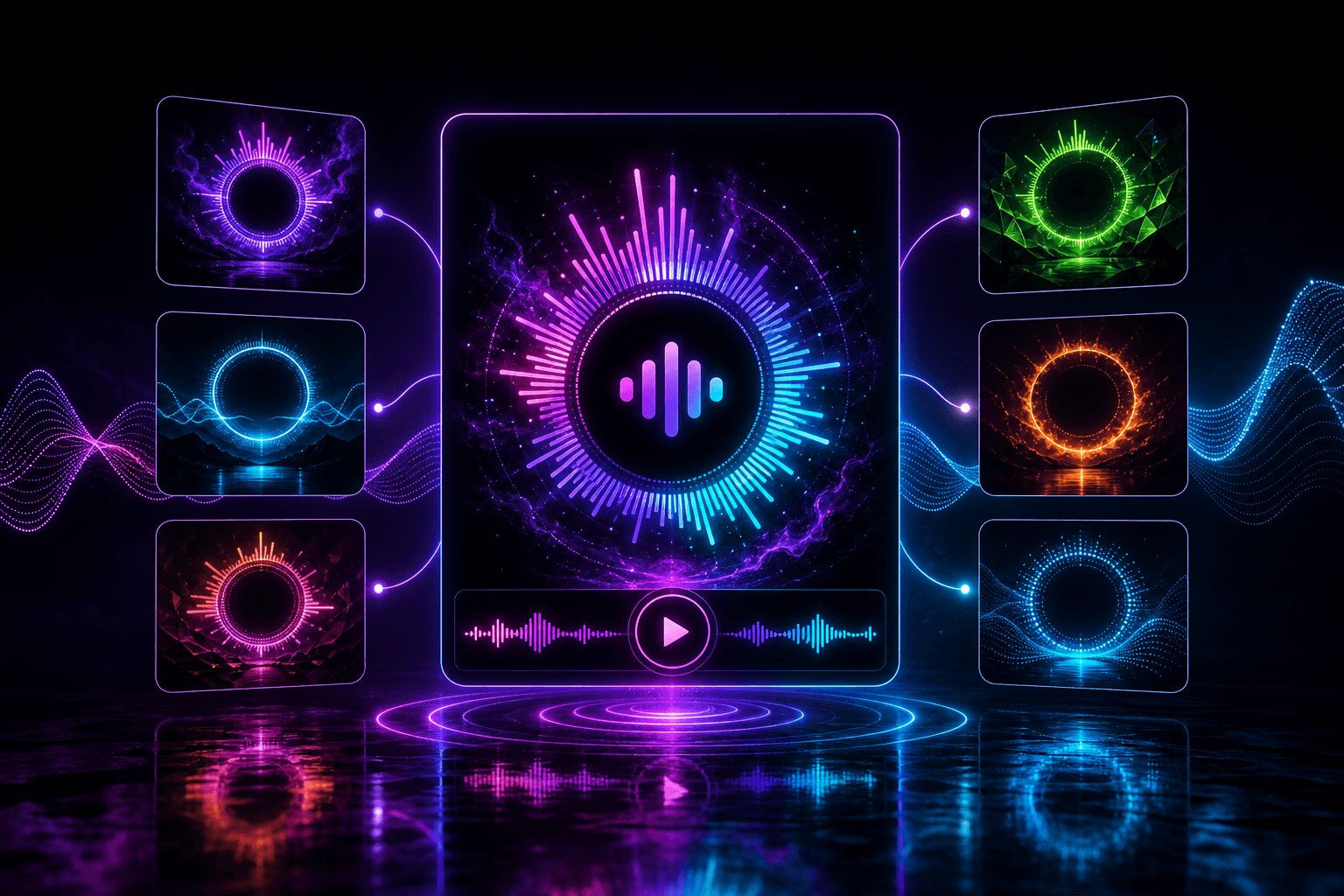
Preview Before You Commit: Template Audio, Six-Mode Cycling & Logo Crown
How Novus template cards play real sample audio, cycle an engine's six modes on hover, and how Logo Crown turns a brand mark into a radial visualizer you can open in Studio or Classic.
Read
Visualizer Engines7 min read
The Right Visualizer Mode for Every Genre: 54 Looks, Sorted
Genre-by-genre picks from all 60 looks: the best engine and mode for EDM, hip-hop, ambient, rock, pop and jazz, with Beat Response settings for each.
Read
Visualizer Engines9 min read
Meet the Novus Visualizer Engines: A Guided Tour of All 60 Looks
A tour of all ten Novus engines (Particles, Trails, Bloom, Character Motion, Radial, Spectrum, Bars, Tunnel, Waveform and Logo), with a standout mode for each.
Read
Visualizer Engines9 min read
Choosing the Right Visualizer Engine for Your Genre
EDM, lo-fi, ambient, rock or lyric-led: a practical guide to matching a visualizer style to your track, with engine picks and color-theme tips for each.
Read