Optical Illusions
Every optical illusion, played by your music
6 classic optical illusions, each drawn in code from the principle behind it and driven by your song. Pick one to open it in the editor, or open the Optical Illusions template and choose one there.
Safe viewing: some optical illusions can make people feel dizzy, queasy or uneasy, and a few people are sensitive to flashing lights and strong patterns. Every illusion here is drawn within broadcast limits for flashes and regular patterns, and turning Contrast down (Calm) softens any of them further. If one makes you feel unwell, look away and take a break.
Motion
Still pictures that seem to move, and moving ones that move the wrong way.
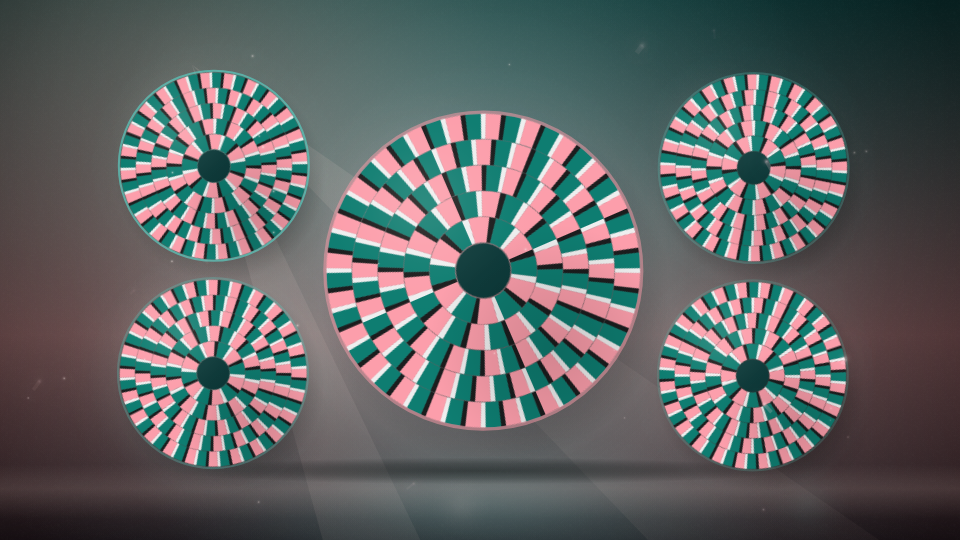
Peripheral drift
Rings of segments in a lopsided order of black, dark grey, white and light grey seem to turn, though nothing moves.
Described by Faubert and Herbert, 1999, after Fraser and Wilcox's escalator illusion (1979); Kitaoka and Ashida reversed the greys in 2003, and Kitaoka's Rotating Snakes made it famous.
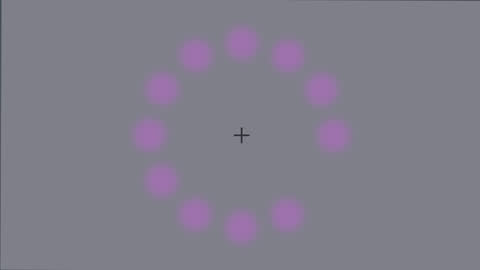
Lilac chaser
Stare at the cross while one of twelve soft discs vanishes in turn: a green phantom runs round and the lilac discs fade away.
Described by Jeremy Hinton, before 2005 (he blurred the discs in 2005); Michael Bach named it the Lilac Chaser.
Size and line
Straight lines that look bent, equal lengths and sizes that look different.
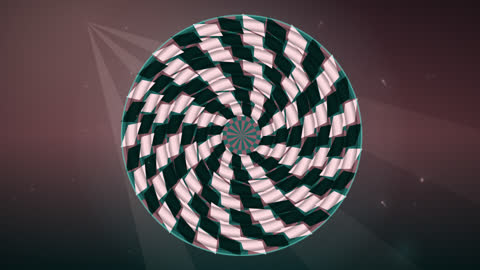
Fraser spiral
Rings of twisted cord read as one continuous spiral, though they are concentric circles.
Described by Sir James Fraser, 1908, as the twisted cord illusion.
Impossible and ambiguous
Objects that cannot exist and figures with two answers.
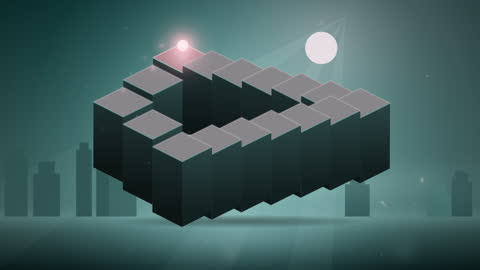
Endless stairs
Four flights of stairs, each step a little higher than the last, close into a loop a climber can go up forever.
Described by Oscar Reutersvärd drew one in 1937; Lionel and Roger Penrose published it in 1958.
Depth and tunnels
Flat pictures that seem to pull you in, swell or ripple in depth.
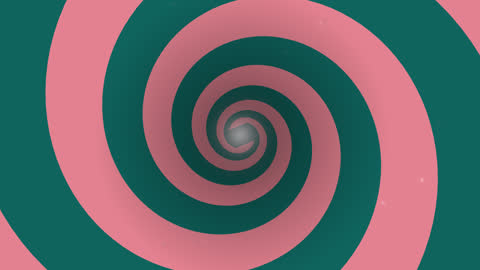
Hypnotic spiral
A turning spiral looks like an endless flow toward its centre, and after a stare a still picture seems to swell.
Described by Joseph Plateau, 1849 (the spiral aftereffect, a form of the motion aftereffect).
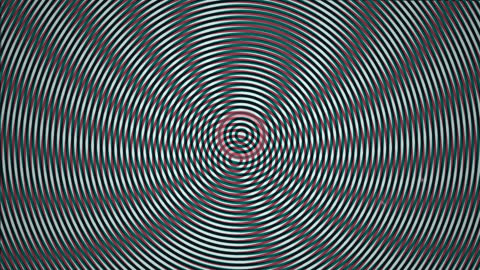
Moiré waves
Two fine ring gratings laid a little apart make broad waves that sweep a long way when one moves a little.
Described by A physical interference effect with no single discoverer, named after moiré, a watered silk.
Six ways to show any illusion
Every illusion plays in each of the template's six looks, the moments it has with the music.
- The Illusion
- The illusion itself, played the way that shows it best and set on its own lit stage: wheels that seem to turn while they stand still under a studio key light, a phantom that runs round a ring on an even grey, stairs that never end in a moonlit courtyard, an endless spiral. The stage's lights pulse with the kick and swell on a drop, every move lands on a beat, and the truth stays hidden.
- The Reveal
- Call and response: each phrase plays the illusion, then answers with the truth over its last bars, with a caption that says what is really there. The loud parts hold the truth longest: the greys slide together and the wheels are seen to be still, the spiral is shown to be circles, the stairs open into a climb with one hidden drop. The illusion comes back when the song calms.
- Gallery
- The illusion framed on a gallery wall under its own picture light, then the others of its family down the wall. The camera holds on each frame for a phrase and pulls back to move on to the next over its last bars, the room's lights dipping as it goes, with each one's name and year on a plaque and visitors passing below.
- Op Art Wall
- The illusion tiled into a full-frame op art wall in its own colours, one tile at a time lit at full strength and the light stepping to another each bar, a soft key sweeping the wall with the kick, kept within broadcast pattern limits. Peripheral drift becomes one framed panel of mirrored bands, the way the principle was first shown.
- Projection
- The illusion projected on the big screen of a hall, in real 3D: the screen fills most of the frame and lights the room, the projector's beam through drifting dust answers the beat, and the camera cuts between a still close-up and a push-in from medium range on each phrase. Illusions that need a steady eye or a straight-on view get a held camera.
- Stare Challenge
- Look at the dot. A ring fills round it and a countdown in bars runs to the song's drop (longer when the illusion needs it), then on the drop the payoff: the dot jumps and the still wheels lurch, the spiral stops and the still picture swells, the lilac discs are long gone.
Every illusion is drawn from its published principle; nobody's illusion artwork is copied. Each is credited to the person who described it, and the template keeps its first version under Earlier versions.