Engine · v4.0.0
Spectrum
Frequency-domain lines, areas, ribbons, spectrograms, ridges, and meshes.
6 modes
Launch modes
50 controls
Controls
| Control | Group | Type | Default | Animation | Audio |
|---|---|---|---|---|---|
| Primary colorPrimary color used by the engine palette | Style | color | #8b5cf6 | Yes | No |
| Secondary colorSecondary color used by the engine palette | Style | color | #22d3ee | Yes | No |
| BackgroundBackground used by the engine palette | Style | color | #050510 | Yes | No |
| OpacityVisualizer opacity | Transform | range | 1 | Yes | No |
| Frame marginBreathing room kept clear at the frame edges. Audio-driven geometry is soft-limited to fit inside it; geometry scale deliberately is not | Transform | range | 0.035 | Yes | No |
| SensitivityBounded overall audio response | Audio | range | 1 | Yes | No |
| Spectrum rangeHow much of the 40 Hz to 14 kHz range the visual spans, from the bass up. Lower it to give the bass and mids more of the bars | Audio | range | 1 | Yes | No |
| Frequency scaleHow the bars are spread across the frequencies. Log spreads them by octave, mel by how pitch is heard, and linear by hertz, which gives most bars to the highs | Audio | select | log | No | No |
| Auto-levelLifts every part of the spectrum to its own recent range, so quiet highs move as much as loud bass. A note held for several seconds settles lower as it adapts. 0 shows the raw spectrum | Audio | range | 0.8 | Yes | No |
| Primary audio sourcePrimary audio source | Audio | select | bass | No | No |
| Frequency focusWhich part of the spectrum drives this visual; while no explicit audio source is set, the motion envelope follows this selection | Audio | select | full | No | No |
| Burst intensityGlow and trail swell on sharp hits; 0 keeps bursts off | Audio | range | 0 | Yes | No |
| Ambient bedProminence of the standing background layer behind the beat-born elements | Effects | range | 1 | Yes | No |
| Wake lengthHow far motion trails stretch behind beat-born travelers; 0 removes the wake | Effects | range | 1 | Yes | No |
| Audio contributionMaximum contribution from the primary audio route | Audio | range | 0.55 | Yes | No |
| Audio dynamicsHow much of the band's movement reaches the visual. 1 = full dynamics; 0 holds it at a steady level for a calmer, more constant look | Audio | range | 1 | Yes | No |
| Audio attackEnvelope attack in milliseconds | Audio | range | 45 | Yes | No |
| Audio releaseEnvelope release in milliseconds | Audio | range | 240 | Yes | No |
| Geometry scaleGeometry scale | Geometry | range | 1 | Yes | Yes |
| ThicknessThickness | Geometry | range | 2 | Yes | Yes |
| Noise deformationNoise deformation | Geometry | range | 0 | Yes | Yes |
| Motion directionRotate the animated visual pass to face this direction; the general background stays fixed | Motion | select | none | No | No |
| SpeedTime-based motion; default major cycle is 6–12 seconds | Motion | range | 0.1 | Yes | Yes |
| Color modeDuo palette, primary→secondary gradient, or full rainbow sweep | Style | select | duo | No | No |
| GlowGlow | Effects | range | 0.55 | Yes | Yes |
| Global glowShared emissive strength across the frame | Effects | range | 0.35 | Yes | Yes |
| Pulse intensityBeat pulse scale for spawn, size, and shake | Effects | range | 1 | Yes | Yes |
| Beat responseHow hard every engine hits on each detected beat | Audio | range | 1.2 | Yes | Yes |
| Beat smoothingHow long each beat hit rings out before it settles | Audio | range | 0.35 | Yes | Yes |
| Beat attackSeconds for a hit to swell to full. 0 snaps instantly | Audio | range | 0 | Yes | Yes |
| Beat releaseSeconds for a hit to fade, overriding Beat smoothing. 0 follows it | Audio | range | 0 | Yes | Yes |
| Beat shakeFrame kick strength on each beat | Effects | range | 0.6 | Yes | Yes |
| Motion echoMotion echo | Effects | range | 0 | Yes | Yes |
| BlurBlur | Effects | range | 0 | Yes | Yes |
| Chromatic aberrationChromatic aberration | Effects | range | 0 | Yes | Yes |
| Beat sync allRoute beat energy into spawn, shake, pulse, speed, and scale | Audio | boolean | true | No | No |
| Symmetry and tilingReshape the whole picture: mirror it, fold it into a kaleidoscope, or tile it (the plane groups p1, p2, p4m and p6m) | Shape and symmetry | select | none | No | No |
| Kaleidoscope foldsHow many mirrored copies go round the kaleidoscope | Shape and symmetry | range | 6 | Yes | No |
| Symmetry angleTurns the mirror line, or the kaleidoscope, in degrees | Shape and symmetry | range | 0 | Yes | Yes |
| Kaleidoscope spinHow fast the kaleidoscope turns, in turns per bar of the song (0.25 is once a phrase) | Shape and symmetry | range | 0 | Yes | Yes |
| Tile sizeEach tile's size as a share of the frame | Shape and symmetry | range | 0.5 | Yes | No |
| Tile gapThe gap between tiles, as a share of a tile; it shows the background colour | Shape and symmetry | range | 0 | Yes | No |
| WarpBend the whole picture: a twist, a bulge, waves or ripples that move once a bar, a polar unroll, or a fisheye lens | Shape and symmetry | select | none | No | No |
| Warp amountHow strong the warp is | Shape and symmetry | range | 0.5 | Yes | Yes |
| Warp centreWhere the warp is centred in the frame | Shape and symmetry | select | centre | No | No |
| BinsResampled visible bin count | Spectrum | range | 96 | Yes | No |
| HistorySpectral history frames | Spectrum | range | 64 | Yes | No |
| SmoothingSmoothing | Spectrum | range | 0.72 | Yes | Yes |
| Vertical anchorWhere the spectrum baseline sits in the frame | Spectrum | select | bottom | No | No |
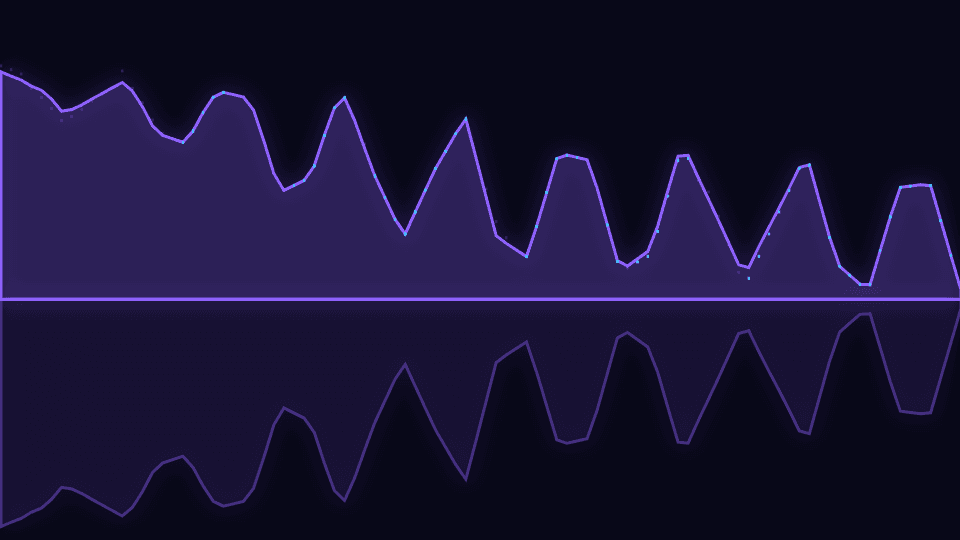
| Mirror reflectionReflect the spectrum across its baseline (floor-reflection look) | Spectrum | boolean | false | No | No |